Our scientific contributions
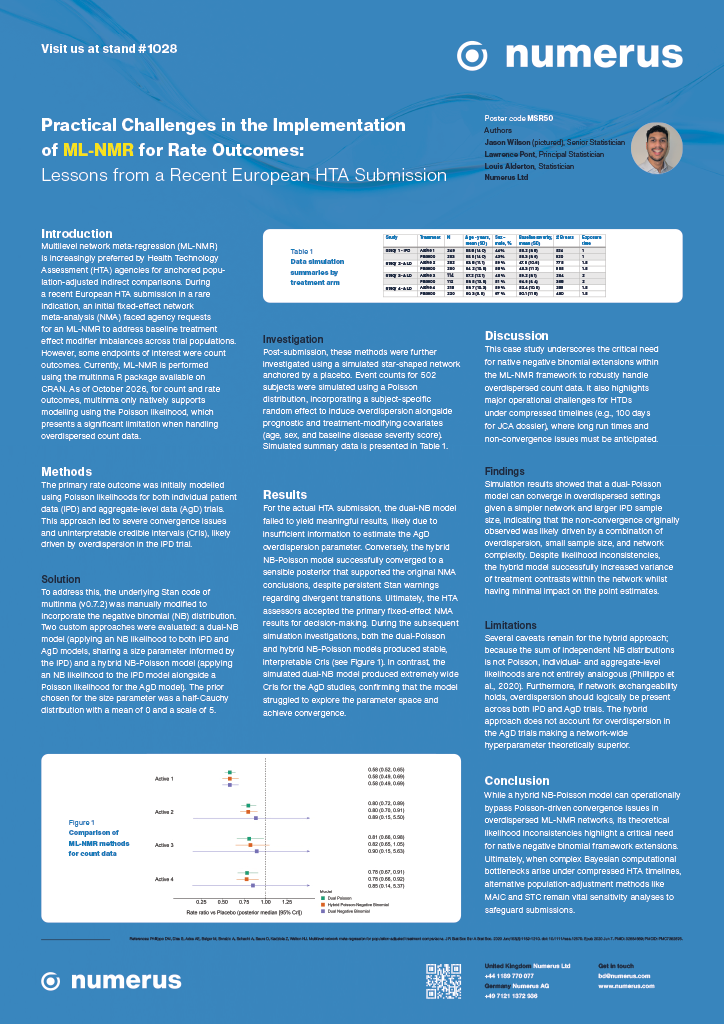
Implementation of ML-NMR for Rate Outcomes: Lessons from a Recent EU HTA Submission
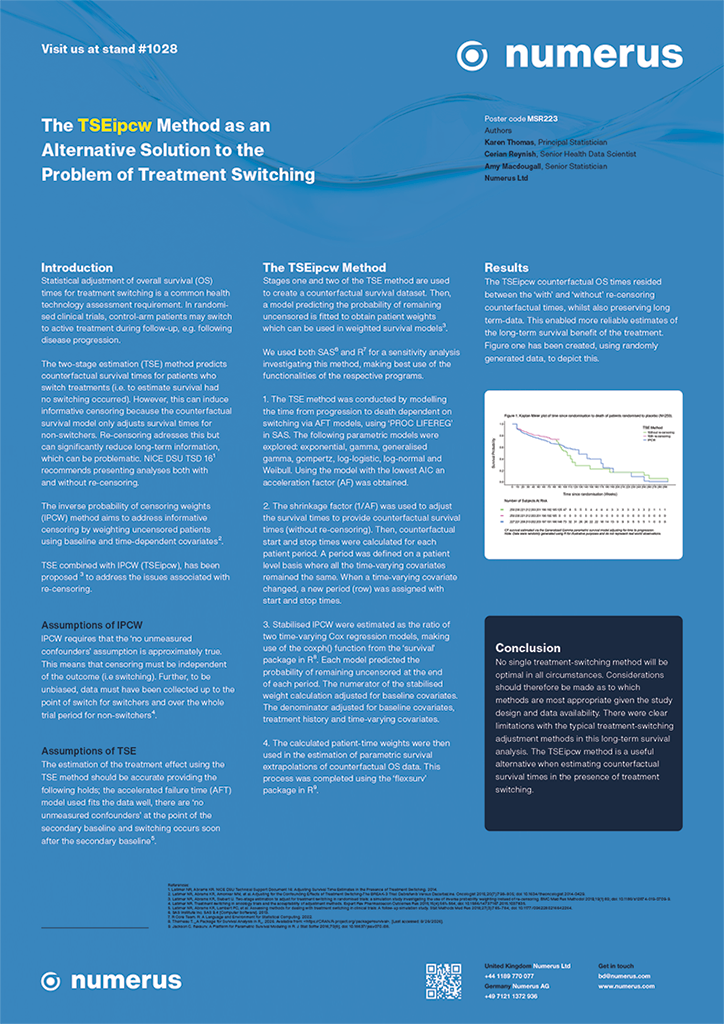
The TSEipcw method as an alternative solution to the problem of treatment switching
Advancing Statistical Methods
Exploring the application of ML-NMR and TSEipcw in health technology assessment.
Diabetic Macular Edema
Numerus invented a new MAIC methodology
The procedure is easy to program and outperforms other methods (eg. Signorovitch). It was initially designed for use in a phase II oncology trial, but can be easily used in various environments.
Multiple Sclerosis
Hyper complex NMA successfully executed
Network meta-analysis of the impact of MRI activity upon outcomes in subjects with Multiple Sclerosis.
Goal was to quantify the relationships between clinical outcomes, quality of life (QoL), and health resource utilisation (HRU) among adult patients using aggregate-level published data obtained from 41 phase II/III randomised controlled trials.
Methods included use of directed acyclic graphs (DAGs) and development of meta-analytic structural equation models
Documented in a statistical report that lead to a client publication.
Analysis concluded by demonstrating clear statistical evidence of a relationship between outcomes.
Multiple Myeloma
Estimating counterfactual survival times using a 2-stage model
Goal was to develop new evidence of a treatment benefit for a German HTA dossier.
Numerus proposed an adjustment the analysis of survival for confounding caused by receipt of additional therapies.
A neutral survival benefit was turned into a positive benefit.
This provided the main focus of the HTA dossier which helped yield a better than expected recommendation from the reimbursement authority, although the methodology itself was challenged.
“I want to express my gratitude and appreciation for the hard work you’ve put into the outputs for this project. Thank you for your flexibility and resilience throughout. Ultimately, the fact that no other analyses are needed now is a testament to the quality of your work.”

Therapeutic experience